HeadImage

HeadImage
Showing posts with label Ireland. Show all posts

Tuesday 4 April 2017

Cloone co-op building

When I lived in Leitrim, this building was at the top of my road.
It was a pity it was empty and boarded up. Because I am sure it was a thriving place for community business.
Cooperatives were a big thing in Ireland, for farmers and maybe groceries too.

Friday 6 January 2017

Waste sorting in public places

Dublin Airport has got a new bin system.
There are three sections:
  • Paper and cardboard
  • Plastic and cans (includes plastic bags!)
  • General Waste

Colour

Each section is a different colour.
  • Blue for paper and cardboard (I think of blue for water, ie liquid, ie drinking, ie bottles)
  • Green for plastic and cans (Green in my mind does not equal plastic or cans! Green is trees...!)
  • Black for general waste (Yes, I think this colour makes sense).
In Ireland, our recycling wheelie bins come in a multitude of colours: orange, black, green, blue, brown. I think our heads are geared to black for general waste; brown for composting; green for recycling.

 I'd like to think that such colours are innately understood but we're not there yet.

Shape

The holes for each section are shaped differently
  • Rectangular for paper/cardboard (I think this is logical)
  • Circular for plastic and cans (circular is the obvious shape for bottles and can and drinking vessels, however this bin takes all kinds of plastic - bags etc)
  • Square for general waste
The largest shaped opening is for general waste and I think this makes sense. However, although I think black is a good choice of colour for general waste, this opening is not the most appealing or "go-to". I think the idea of shapes is excellent, however this solution is not quite there yet.

Size

All the bins are the same size; I wonder if they could be narrower or smaller or different heights?

Design: a lot done, more to do

I am impressed but this is a protoype in my opinion.There are good design ideas but it's not quite there yet. I love that it is bilingual and I like the non-language-specific icons.


Saturday 1 October 2016

An Irish conversation

This conversation happened on whatsapp between me and one of my fellow students:
If this were an Icelandic conversation, the answer would be "Room 256" or whatever, and the poor questioner would be left sitting there for an hour.
Whereas, because it's Ireland, the question presumes that the person asking is in a room for a 9 o'clock lecture and is puzzled because no-one else is there. Unspoken. And yet the person answering could read between those lines and gave the requisite answer although, arguably, not the answer to the question.
Fascinating!
(Maybe it's not an Irish thing, maybe this happens with other cultures too, but I recognise it as Irish and it certainly contrasts with my Icelandic experiences)

Friday 12 December 2014

Natural Dyes

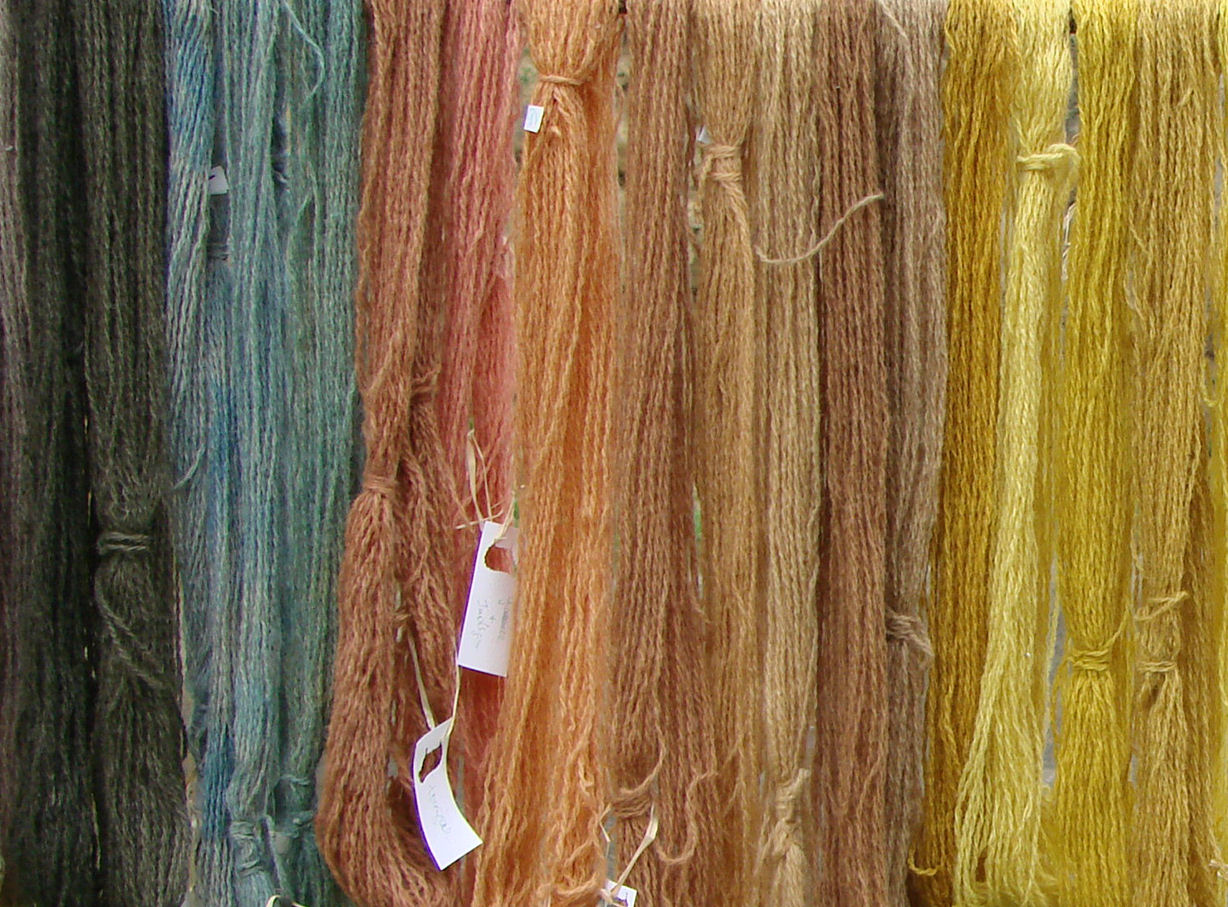
I visited The National Folklore Collection (NFC) yesterday and was privileged to view the contents of a beautiful wooden box. The box contained wool samples. Each sample of wool had been dyed naturally. The name on the presentation boards is Evelyn Lyndsay. Staff at the NFC said they thought Lillias Mitchell had bequeathed the box who, they thought, was her niece. I should go back and look at all the records for accurate information.

Mordants

  • Alum
  • Chrome
  • Iron
  • Tin
  • Cream of Tartar - tartaric acid
  • Oxalic acid
  • Soda - bicarbonate of soda
  • Vinegar - weak acetic acid
  • Ammonia

Non-poisonous plants needing no mordant

 (To use with young children)
  • ash twigs
  • beetroot
  • blackberries
  • horsechestnuts
  • onion skins
  • pine cones
  • red cabbage leaves
  • tea leaves

Suggested books

A Dyer's Manual Jill Goodwin
Dyes from the Kitchen Green / Ashburner
The Use of Vegetable Dyes Thurston
A Modern Herbal Mrs Greene
Wild Flowers in Colour Penguin
Tree Recognition John Kilbracken
The Observer's Book of Lichens K Alvin
Spinning and Dyeing Dalby / Christmas

Interesting colours

The numbers are the referrencing system used on the display board, I type them here for ease of finding them again next time I'm in and to keep my notes all together.
12h - Blackberry - root - oxalic acid
13a - Black Crottle - Parrnelia omphalodes - lichen [lovely deep brown]
15b&c - Bracken - fronds - b:chrome; c: alum + iron

26c - Leavers - Galium aparine - roots
65a - Lady's bedstraws - Galium vernum - roots - alum
87c - Red Cabbage - leaves - chrome [blue colour]
109d - Weld -Reseda luteola - whole plant - alum + iron

No Mordant:

Without doubt, the deeper coloured yarns are from dyes which use another substance ("mordant") as well as the plant substance; I suppose I only discovered this when I compiled this list and looked at the colours. 
1a - Apple - Pyrus malus - bark 
2a - Ash - Fraxinus excelsior - bark
8a - Barberry - Berberis spp. - inner bark
9a - Beetroot - Beta vulgaris - root [yellow]
12c - Blackberry - Rubus fruiticosus - frozen fruit [brown]
13a - Black Crottle - Parrnelia omphalodes - lichen [lovely deep brown]
16a - Buddleia globosa - flowers
27a - Coffee - Coffea arabica - grounds
30a - Crottle - Parmelia Saxatilis - lichen
44a - Flowering Crab Apple - Malus - bark
58a - Horsechestnut - Aesculus hippocastanum - nuts
71a - Mahonia Japonica - inner bark
76a - Onion - Allium cepa spp. - skins
87a - Red Cabbage - Brassica oleracea - leaves [blue]
92a - Rhubarb - Rheum rhaponticum -leaves
92f - Rhubarb - Rheum rhaponticum - root
99a - Sea Ivory
103a - Tea
110a - Wild Iris
114d - Yew - wood chip
115a - Coal - ash
115d - Coal - dust
116a - Soot
147a - Rose - Rosa spp. - roots
159a - Waterlily - roots
164a - Eucalyptus - root

Monday 28 October 2013

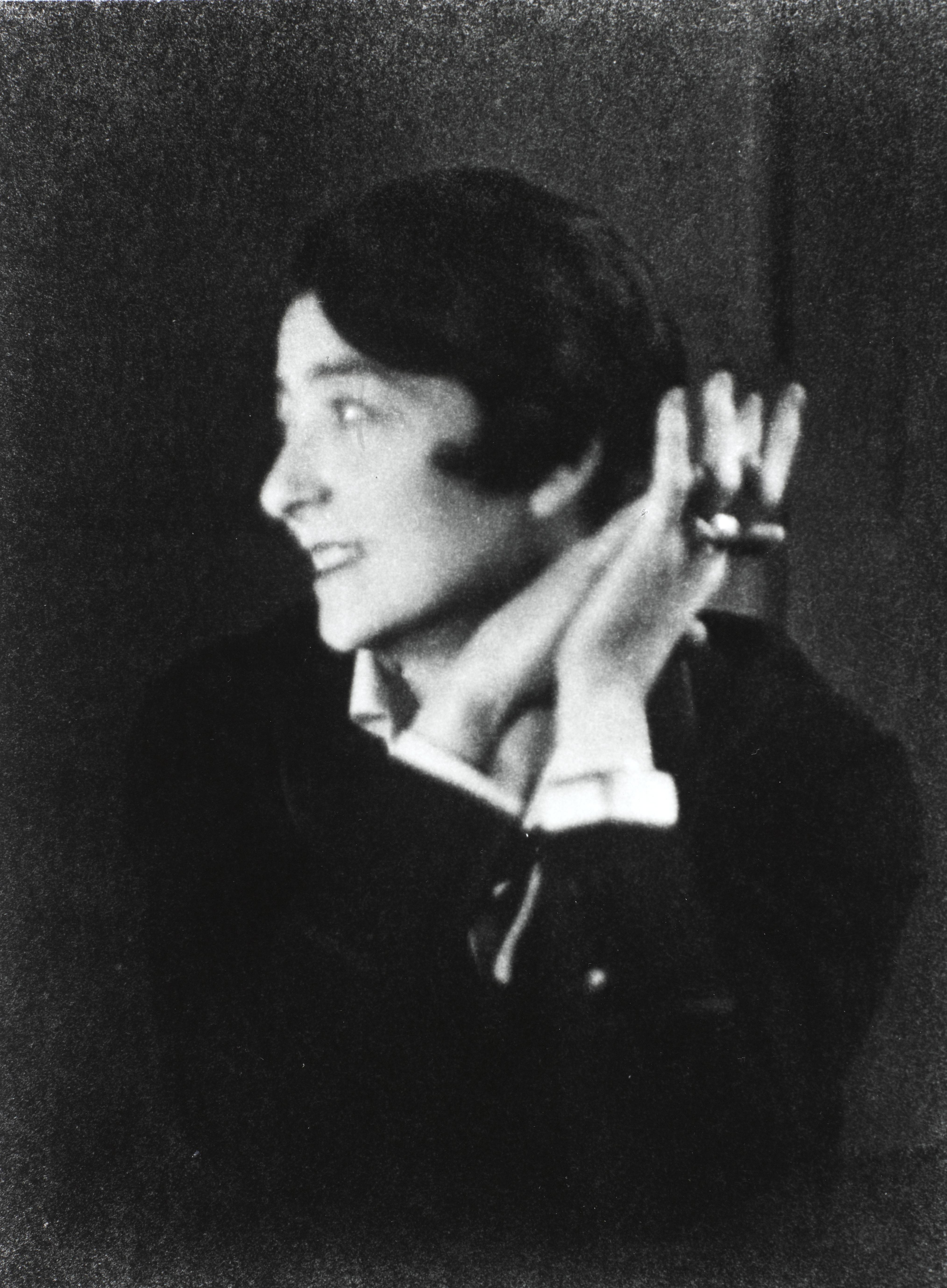
Eileen Gray at IMMA

Visited the Eileen Gray exhibition at the Irish Museum of Modern Art (IMMA) in Dublin today. A perfect activity for a bank holiday monday - and we weren't alone in thinking that, a government minster and a radio broadcaster also visited the museum at the same time!
We claim Eileen Gray as one of our greatest Irish architect/design/artists. But she spent her working life in France. The houses she had built are on the Côte d'Azur. But of all the copies of letters, the video recordings, imagery etc, there wasn't any in French; we didn't get a feel for the francophile aspect of Eileen's life. Even though the exhibition is supported by the Centre Pompidou.
There are beautiful pieces on display, and personal letters to someone called Pru (I never did find out who she was or what their relationship was), and articles by contemporaries praising Ms Gray's works and ideas. Le Corbusier makes an appearance. There is information about lacquering, the shop she had on Rue de Saint-Honoré in Paris and more.
Having studied architecture, I was familiar with her work and E-1027. I appreciate the effort of her design, the consideration put into finding solutions to particular problems in unique situations.
For example, a stunning dressing-cupboard. Used as a divider between the sleeping section of the room and another section (can't remember exactly).
There are shelves of different heights. Glass shelves. Wonderful hinged-drawers which swing out from one side. A full-length mirror. It's wonderful. All the more wonderful considering the precise location for which this object was designed. And the multiple functions it fulfills. The obvious functions which we can see in this exhibit - a dressing-table/cupboard; and the not-so-obvious which we can deduce from house plans and photographs - as room divider in a particular house interior.
And that's the problem I have with the exhibition overall. It's wonderful for a designer and trained architect like myself or to someone who is not coming to Eileen Gray for the first time, someone who reads plans and drawings, is familiar with the design scene of the age... but without that education this exhibition seems to be about objects of furniture, items without context, rug designs without rooms in which to put them or clients to own them.
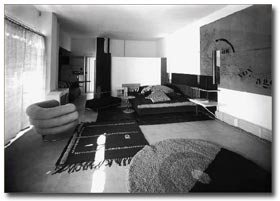
Which is not what it's about for me. See this interior photograph - see the circular rug and circular pattern, that uncomfortable circular Michelin-man-esque chair, and the wall decoration with it's semi-circular arc. The objects are designed to be in this space. The chair is ok if it's uncomfortable - the room is a bedroom not a sitting room!
I'm disappointed. Nevertheless, the exhibition showed me some new sides to Eileen Gray - lamp designs and that interiors shop. She was great - but why was she great, oh curator, why?

Friday 11 May 2012

Church at Laytown

Recently I went for a walk by the sea at Laytown, Co. Meath.
And came across a church with a stunning window behind the altar that overlooked the sea with its waves and everchanging atmospheres.
I suspect the church may be designed by the architect, Liam McCormick, and think its name is Sacred Heart Church.
The old (19th Century?) facade is retained, a glass 'corridor' is placed behind it, entering into the modern ceiling-lit space. The front elevation clearly shows the old facade, with white angelic-like wings either side (the rounded 'body' of the new building) and sky visible in the upper openings where windows used to be.

Thursday 26 April 2012

Irish Sewing Blogs and suppliers

I'm off work for a few days, off sick and not up to much other than sitting up in bed with my laptop and surfing and planning projects and things to do when I'm back to myself.
Yesterday, I got immersed in sewing patterns... and blogs and fabrics... I ended up spending almost €100.
Today, it struck me that I should have a trawl around the web for local bloggers, and find out where they source their patterns and their fabrics and notions. How do they avoid paying overseas postage and packaging... etc.
I'm going to start off with a "disclaimer" and that is my disinterest in quilting and patchworking so I have quickly left blogs on those topics that I have come across rightly or wrongly. Wrongly, undoubtedly, because there is something to be learnt from everything but the sheer amount of blogs and postings causes me to impose some kind of 'rules'.

A great start: Etsy Ireland Crafty Team - but they seem to be quite beady and cardy and crafty orientated as opposed to sewing specific. Hmm. This sourcing is tough.

Fiona in Dublin has an Etsy shop called Threads2000 selling 100% egyptian cotton threads sourced from Greece.

Fabric Shops in Dublin:
Hickey's on Mary or Henry Street (can never remember where on starts and the other ends)
Murphy Sheehy's near the Powerscourt Shopping Centre and Grogan's Bar
Woolen Mills, near Ha'penny Bridge on North Side (upstairs for the big range of fabric)
TWI, 24 Mountjoy Square East - I haven't been here yet.
Ikea

Other crafty shops in Dublin:
The Yellow Brick Road, Bachelor's Walk (though I think it may have closed down?!)
Trimmings shop on quays near beside Crown Alley / Temple Bar / Ha'penny Bridge
Rubenesque in Powerscourt Shopping Centre (used to have shop next to the music shop but may have moved from there into bigger premises)

Knitting shops:
Craft Cottage, Ratoath, Co. Meath
Trim, Co. Meath
Winnie's Wool Wagon, Woodbine, Booterstown (near UCD), Co. Dublin
woolshop in Swan Centre, Rathmines, Co. Dublin
This is Knit, Powerscourt Centre, Dublin
The Gingham Duck, Sligo

Lots of info on Knitting Classes in Ireland. I keep getting distracted by information that is available as opposed to the information that I want.


The Crafter's Basket, North Sligo - have the facility for selling patterns but none in online shop as I look today. Sells fabric, vilene, a dressmakers dummy, sewing machines and other items.

Yay! I've found Pippablue. She's blogging from Galway, Ireland. Further investigation... there's an online Pippablue Shop - hurrah! The list of products is potentially very exciting... but the stock is very low. One to keep an eye on, I suppose. The real shop is on 1 Middle Street, Galway City.

Just Judith is in Belfast - a quilter though, not my métier!
A room in a cottage - sewing homewares made in Ireland
Sarah from Cork is also a quilter
Fluffy Sheep Quilting is based in Ireland... but I think the clue is in the name! She has blogged a brilliant list of quilting fabric stockists in Ireland
Emily lives in Ireland and she likes to make things... here's hoping there'll be a link or two to a whole world of Irish bloggers in her blogstream....
Linda Coleman is in Dublin. Her projects seem different to mine but I might steal a friend from her blogging community.
Cuada are a textile designer in South West Ireland... website seems to just sell finished products.
Millie (the same name as my Gran!) lives on a dairy farm in Ireland and she SEWS. Just like me. My hopes are raised again.
The Roma and Mary blog is kept by Amanda in Ireland who likes a variety of handiwork and crafts, including sewing, she says.

A lot of these links were found using the "Sew Irish" group on flicker. But many of the members of that group are not based in Ireland. I just think in terms of sourcing materials and fabrics and patterns, and sew alongs (for practical time-zone-related reasons!) that it would be nice to be part of a community of Irish amateur dressmakers. But maybe my expectations are too high. I have a few leads and will follow them later.

Thursday 22 April 2010

A busstop on a wall


picture taken in Moone, Co. Kildare of this old bus-stop mounted on a wall.

Friday 16 April 2010

The Bridge in Ireland inspired by a Harp

I've always been quite cynical about the idea that the Calatrava bridge at Macken Street was inspired by a harp. How fitting?! How handy! The harp is a native symbol of Ireland. Strings are cables. And curved steel can imitate curved carved wood.
Santiago Calatrava has designed other bridges in similar style:
  • Serreria Bridge in Valenica, Spain
  • Footbridge Puerto Mujer, Buenos Aires, Argentina
  • Light Rail Train Bridge, Jerusalem, Israel
  • Katehaki Bridge, Athens, Greece
  • Sundial Bridge at Turtle Bay, California, USA
  • an early design for the Alamillo Bridge, Seville, Spain
But today, listening to Morning Ireland on Radio One, I was alerted to Love:Live Music day. One of the many free performances involved 12 harpists, strewn across the bridge playing music.
When I arrived at lunchtime today (thankfully) there was no strew-ing. On the south-side, there was a cluster of harpists strumming Carolan tunes harmoniously. And I thought (I love Carolan's music) that perhaps this connection might not be a bad thing... and might possibly, I conceded, be intentional. Because the Beckett bridge does join the mast and the flat bridge at a particularly graceful angle and the steel given a particular design treatment at this point.
However, I am far from convinced - mostly because a harp on its side is a daft symbol!
Similarly, the bridge in Greece claims to be inspired by Athenian sailboats - perhaps part of the designer's charm is making these tenuous links between a generic, international bridge design and the native culture.I've tried rotating an image of the bridge and comparing it to a harp - the most noticeable difference/mismatch is that the strings on a harp run from the flat towards the top which is concave. If we are to look at the cables on the bridge running from the flat - they go towards a convex curve.
Too much analysis always spoils the fun so I'll finish by admiring the heavy steel at the base of the mast again - that shape and angle and mould and curve does bring a harp to mind.

Wednesday 24 March 2010

National Print Museum

The National Print Museum of Ireland is located in an old barracks which now houses, amongst other offices, the Labour Court. It's on Haddington Road in Ballsbridge. I have intended calling in there for a long time and finally, I paid my visit. I think I found the location a bit daunting. After passing through that great stone gateway, would I be able to find my way. A check beforehand of the website helped. A sign in the window of a building in the yard anouncing "Free Exhibition" didn't. The sign and the building had nothing to do with the Print Museum.

The Museum is in the former Chapel.

Passed through the coffee-shop/tea-room, greeted by a girl at reception/shop, given an individual guided tour while an elderly man used the machinery - he was printing a poetry book, I think. All the machines are in working order.
One definite thing I learnt, was that the letters we often associate with old print presses - be they in wood or copper (maybe) - those letters are only moulds. Each time a document is printed, new letters are formed - from a silvery metal, using those moulds. So one of the machines in the process is just making little letters from moulds - either monotype (each letter is done singly) or linetype (where a line of letters is formed stuck together and this of course can be justified - an amazing rotary thing figures out the gap required when all the moulds in the line of print are in place).
Wow! An education! And no doubt, much more to be learnt.
If I brave the yard again!

Thursday 18 June 2009

Museum of Style Icons


The Newbridge Silverware Museum of Style Icons made for a great day out. Free entry. Full of items.
Curating could have been a little less haphazard and a little more organised. The idea behind the displays wasn't always consistent. Having the umbrella from the photographs or the costumes from the films is a gorgeous idea - shame the video screens weren't working.

Thursday 14 May 2009

Calatrava's Dublin Bridge #2 arrives in Dublin

I missed it!! I was away for the weekend and not up to scratch on the goings-on in Dublin. The second of Calatrava's bridges arrived into the Liffey yesterday. It was sitting outside the East Link Bridge in Dublin port since Monday, waiting for ideal tidal and wind conditions.
Apparently, the opening of the East Link was only just wide enough to let the bridge (at a particular point) pass through and so the tide had to be at its highest point.
I wrote an article about the two bridge designs in Blianiris, an Irish language publication in 2004. It almost felt like a friend I hadn't seen in a while had returned again when I saw the bridge coming into the city on the news yesterday.
The bridge is moored in the Liffey and will be anchored in place in June. I mustn't miss that date!

Thursday 8 January 2009

Planning the Red Cow

The Red Cow intersection changes every time I see it. I visit Clondalkin about once a month and each time the road layout is different. How a project manager can keep track of it is astounding. It must be by far the biggest project we've done in Ireland. There are temporary roads and bridges and signs. Construction is happening for the next stage of the final road as well as the next stage of temporary road.

It looks nothing like the picture at the moment.

I'm not claiming the project is without fault, I don't know (and did notice two roads diverging with no clue as to which went where) but the sheer size is mind-boggling. To think someone plans it!!!

Wednesday 10 December 2008

The Jewish Museum

At last, I made a visit to the Irish Jewish Museum. I've seen signposts for it in the Portobello area but never quite found it until I made the effort on sunday.
We were greeted at the door by a very helpful man, who later checked if we were doing a project for which he could answer questions and followed us upstairs to ensure the heating was on and the room was warm enough.
The objects and information had a family feel to it, more than community based even. Pictures of people on wedding days, groups of girl guides and boy scouts.
The most interesting panel I thought was about anti-semitism in Ireland, more for the other info that was on the newspaper clippings - an ad from the Dun Emer guild caught my eye.
The panels and display cases were packed full of objects, items, artefacts, newspaper cuttings, passports, documents, photographs, certificates....

Sunday 26 October 2008

Glenview Museum

Went to Ballinamore, Co. Leitrim for the bank holiday weekend. Needed to get out of the city. We had no accommodation booked but drove around, and saw a sign for Glenview B&B. Next to the house, was a notice for "Museum". This morning when we were fixing up with the landlady, she asked us if we wished to see the museum. Yes, we said, we'll pay a quick visit.
Well, it was fantastic! A beautiful vintage car was the first thing we saw when walking into the large, jam-packed shed. And all manner of other objects of interest. The man of the house was willing to give us a tour, and seemed to have stories of interest to share about each and every item on display. Unfortunately, we were limited for time and hadn't expected to discover such a treasure trove so we had to be rude and stay only for a few minutes, making promises to return.
He played music for us on a gramaphone, and showed off a tiny iron for pressing lace collars, a magnificent wall-hanging collapsible clothes-horse, a door with a bullet hole from the black 'n' tans; among others.
As I wrote in the visitor's book "I'll be back".

www.glenview-house.com/glenview-museum.html

Friday 12 September 2008

Green post boxes

I've been a fan of these postboxes for a while now.
If you see beyond the green - Irish National Colour, don't forget! - and look at the writing on the box above, you'll see a crown sitting above the letters ER.
There are also postboxes with VR and others with GR.
The British Monarchs they refer to are:
George V 1910–1936 (26 years reign)
Edward VII 1901–1910 (9 years reign)
Victoria 1837–1901 (64 years reign)
I've never spotted one with WR but if it existed it would be even older and would refer to:
William IV 1830–1837

The story goes that when the Irish republic was formed, we couldn't afford new postboxes and the good cast iron ones that were in place were perfectly functional - so we simply sent people around with buckets of green paints and thereby nationalised our postboxes!

Wednesday 4 June 2008

Radiohead graphics hijacked

While browsing online for train timetables. I spotted this poster and couldn't help posting it here!
I *love* the way they've used radiohead's graphics on the poster!!!

Sunday 13 April 2008

Cycle Lane or Footpath?

I cycle to work via the docklands in Dublin. If I'm on the path at around 8:50 it's a nightmare - pedestrians walking on the clearly-marked and well-used cycle path.
Why?!I think I discovered one of the possible reasons the other day. The dustbins!
I was walking along that route and had an apple core in my hand. I spotted the bins and started walking towards them - lo and behold, I'm walking on the cycle path. The bins are located adjacent to the cycle path.What a stupid location! They should be accessible to pedestrians, or to pedestrians and cyclists but surely pedestrians as a priority... I throw my hands up in despair!

Thursday 20 March 2008

Postcards

I love postcards. I always send some from abroad, or even from museums or funny places I go to - I might send a friend a greeting and a picture.
When I was inter-railing I brought a stack of blank postcards with me and sketched what I saw and sent messages on the back of my drawings.
And so this new An Post (yes, them again, see previous less-favourable post!) venture has got me really excited.
It's a collective art exhibition, backed by a website. Anyone can and everyone should take part. Check out:
It's a good website and includes a piece on the history of the postcard.
I'll make sure and post my entry/ies when I submit them.

Thursday 24 January 2008

Quaker Museum

Visited Quaker museum in a wee village in Kildare/Kilkenny today. V enjoyable, interesting quirky. Info about Mary Leadbeater (?), related to Shakletons. Also Edmund Burke was a quarker. Funny layout of info posters - didn't seem to be chronological or informatively ordered, hard to comprehend. Helpful librarian who let us upstairs. One of the three museum rooms was a costume exhibition with a humidifier etc, very professional! I described the experience to a friend this eve and she said "surreal". I just say a different side to life in our wee country - it exists!